
5 Signs Your Business Has Outgrown In-House HR
Spot 5 signs your business has outgrown in-house HR: mounting compliance risks, skyrocketing turnover, talent shortages, neglected strategy, and overwhelmed teams. Discover red flags from real growth stories and learn how outsourcing fixes these issues for scalable success.
Our HR team just botched a compliance audit-fines hit hard. I’ve been there: as my business scaled, in-house HR crumbled under the weight. It’s not just headaches; it’s stunting growth. Spot these 5 signs-mounting legal risks, skyrocketing turnover, talent droughts, neglected strategy, overwhelmed generalists-and you’ll know it’s time to outsource. Ready to fix these warning signs and red flags business before it costs you more?
How HR’s Role Changes in Businesses That Grow
At 10 employees, small business HR means payroll management and benefits administration. At 100 employees HR focuses on talent pipeline and culture architect. This HR evolution happens as businesses experience business growth and face new HR challenges.
Small teams start with basic tasks like payroll processing and simple benefits administration. As the company adds staff, HR handles more complex issues such as employee onboarding and basic compliance. Owners often juggle these administrative burdens themselves at first.
With expansion, HR moves toward strategic work. Think talent acquisition to build a strong workforce and workplace culture building to keep everyone engaged. Yet many small businesses stick with understaffed HR, leading to growth pains.
Deloitte Human Capital Trends points to this strategic shift from tactical HR to strategic HR. Growing firms need HR scalability to match business expansion. Without it, issues like high turnover and hiring challenges pile up.
| Employee Count | HR Focus | Typical Headcount |
|---|---|---|
| 10 | Tactical | 1 FTE |
| 50 | Mixed | 2 FTE |
| 100+ | Strategic | 4+ FTE |
This table shows how HR department size grows with the workforce. At 10 people, one full-time HR person covers basics. By 100, you need a team for performance management and employee relations.
Why Recognizing Growth Limits Matters
Companies ignoring HR limitations often face real setbacks in their path to business expansion. When your in-house HR team can’t keep up, it creates bottlenecks that slow down everything from hiring to compliance. Spotting these signs early helps you avoid bigger problems down the road.
One major risk is turnover cost doubling. High turnover drains time and money on constant recruitment and training, pulling focus from core business growth. Understaffed HR struggles with employee retention, leading to lost knowledge and morale dips across teams.
Compliance issues pile up fast too, with fines potentially jumping 40% for repeat mistakes. Keeping up with labor laws and HR policies becomes overwhelming for a small team, risking legal headaches during business scaling. Regular HR audits fall by the wayside, exposing the company to unnecessary penalties.
- 25% slower hiring means hiring delays and missing out on top talent while competitors snap them up, delaying projects and growth plans.
- Administrative burdens like payroll processing and benefits administration eat into strategic time.
- Overwhelmed HR leads to poor employee onboarding and performance management.
Businesses turning to HR outsourcing, like PEO services, often see faster growth. NSBCA notes PEO services clients grow 2.5x faster by gaining HR scaling solutions without the overhead. This shift lets you focus on what you do best while experts handle the rest.

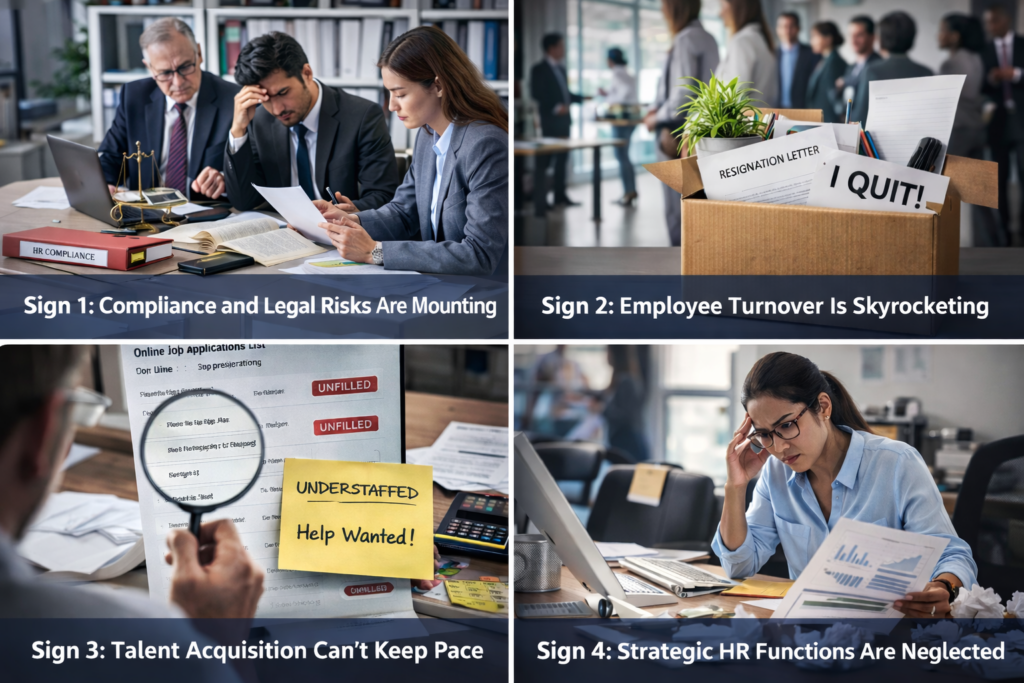
Sign 1: Compliance and Legal Risks Are Mounting
Your in-house HR handles 1-2 compliance risks areas well. At scale, you’re exposed to dozens of federal and state regs all at once. Small businesses often struggle as they grow past a certain size.
SMB HR face more DOL and OSHA claims during business expansion. In-house teams get overwhelmed with the administrative burden. This leads to gaps in legal compliance and rising risks.
Common issues include incomplete paperwork and missed deadlines. Your HR department might focus on daily tasks like payroll processing and employee onboarding. Meanwhile, broader compliance issues build up unnoticed.
Experts recommend regular compliance audits to spot HR pain points early. Consider HR outsourcing or PEO services for better risk management. This shift helps with scalability issues as your workforce grows.
Frequent Audit Failures or Penalties
EEOC regulations claims against SMBs have been on the rise; many point to inadequate documentation. A restaurant chain faced a large FLSA penalty for misclassifying managers as exempt. A tech firm paid a hefty OSHA fine due to incomplete I-9 forms.
Your in-house HR might maintain basics like W-4s, but audits reveal gaps. Here’s a HR best practices checklist of key documents to track:
- I-9 employment eligibility verification
- W-4 employee withholding certificates
- ACA affordability and reporting forms
- OSHA injury logs
- FMLA certification paperwork
- EEOC EEO-1 reports
- State wage theft posters
- policy updates
Review these regularly to avoid penalties. Overwhelmed HR teams often miss updates, leading to fines during inspections. Bringing in HR consulting can help standardize these processes.
Inability to Keep Up with Changing Labor Laws
Labor laws change often at the state level, and overburdened HR can track only a handful. Examples include California’s SB 1162 for pay transparency, New York’s predictive scheduling rules, and Texas restrictions on non-competes. Other states have added rules on minimum wage hikes and paid sick leave.
Your HR team size limits how many you follow. Create a simple compliance matrix by employee count and location. Track about a dozen key laws this way, like FMLA thresholds or ADA accommodations.
Understaffed HR struggles with these updates amid daily tasks like benefits administration. Use HR software for reminders on changes. Fractional HR or outsourcing HR providers often include law tracking as part of their service.
This approach reduces growth pains from compliance issues. It frees your team for strategic HR like talent acquisition and employee retention.
Rising Employee Lawsuits or Claims
Wrongful termination claims hit SMBs hard with high settlement costs. A 75-employee manufacturer settled an FMLA retaliation case for a big payout after HR missed tracking intermittent leave. These situations expose weaknesses in employee relations.
Watch for these signs of outgrowing HR and spiking claims in your org:
- Increase in harassment complaints and grievance handling
- More wage disputes from payroll errors
- FMLA or ADA accommodation requests ignored
- Discrimination allegations during hiring
HR workload piles up with conflict resolution and disciplinary actions. In-house teams lack time for thorough conflict resolution investigations. Outsourcing HR handles claims with experts in termination processes.
Build strong HR policies and an employee handbook to prevent issues. Regular training on labor laws cuts lawsuit risks as your business scales.
Sign 2: Employee Turnover Is Skyrocketing
Healthy employee turnover runs around 10-15%. When yours hits high turnover rate 25% or more, HR processes are broken. Employees leave because of issues like poor onboarding or weak management support.
Replacement costs often reach 50-200% of salary. For a 100-employee firm with 30% turnover, you replace 30 people a year. That adds up to major expenses quickly.
High turnover signals growth pains from business expansion. Your in-house HR struggles with retention strategies and recruitment problems demands. It creates constant hiring challenges and disrupts team morale.
Track your rates monthly to spot trends early. Fix HR bottlenecks before they drain profits and slow business scaling.
Industry-Benchmark Exceeding Rates
Tech sees average employee turnover around 13%, healthcare about 20%, and retail closer to 60%. When your rate beats these industry benchmarks, watch out. It points to HR scalability issues in your growing business.
Red flags include rates over 20% in any field, over 30% voluntary exits, or double the benchmark. These signal outgrown HR unable to handle workforce management and HR capacity.
| Industry | Your Rate | Benchmark | Cost per Turnover |
|---|---|---|---|
| Tech | 25% | 13% | High |
| Healthcare | 35% | 20% | Very High |
| Retail | 70% | 60% | Medium |
Use this table to compare your numbers. If you exceed benchmarks, consider HR outsourcing for better cost efficiency and talent acquisition.
Exit Interviews Revealing HR Process Gaps
Research suggests most voluntary turnover links to manager or HR issues and HR workload. Exit interviews show these gaps clearly. They show where your in-house HR falls short during business growth.
Common flags include poor onboarding process, no clear career paths, and weak employee engagement programs. Employees often cite these in feedback. Use a simple 10-question survey to reveal your specific problems.
- Ask about onboarding process experience and support.
- Probe for career development opportunities.
- Check recognition and engagement levels.
- Rate managers and team dynamics.
- Identify pay or benefits concerns.
- Note HR workload and work-life balance.
- Ask about company culture fit.
- Gauge training and development access.
- Explore compliance or policy issues.
- Invite open comments on improvements.
Review these regularly to increase employee engagement. It helps with succession planning and reduces future high turnover.
Recruitment Costs and cost per hire Eating into Profits
Average replacement runs $15K for mid-level roles and over $50K for seniors. For a server engineer, add agency fees at 25% of salary, $4K in ads, and 200 manager hours at $75 each. That totals around $21K easily.
A cost pyramid has advertising and screening at the base, interviews and onboarding in the middle, and lost productivity at the top. High turnover piles on these layers yearly. It burdens your overhead expenses and HR workload.
Break it down: time-to-hire drags with understaffed HR, agency markups rise, and training restarts constantly. This eats profits during SMB growth. Shift to HR technology or outsourcing for relief.
Calculate your true costs now. Tools like applicant tracking cut hiring challenges“”, but if in-house can’t scale, look at PEO services for operational efficiency.

Sign 3: Talent Acquisition Can’t Keep Pace
Scale requires 2-3x hiring velocity. In-house HR maxes at 40 hires per year. As your business grows, this limit creates hiring challenges that slow down business expansion.
Average time-to-hire sits at 42 days according to SHRM data. Scale-up companies aim for under 25 days. When your HR to recruiter ratio exceeds 75:1, it signals a crisis in talent acquisition.
Your HR department struggles with sourcing, screening, and closing deals fast enough. This leads to missed opportunities in a competitive job market. Consider HR outsourcing to boost HR scalability.
Overwhelmed HR teams face growth pains from understaffed roles. They juggle recruitment process with employee onboarding and performance management. Signs like high turnover point to deeper scalability issues.
Prolonged Time-to-Hire Metrics
42 days average time-to-hire creates bottlenecks. Losing candidates to competitor speed happens often in fast-moving markets. Your in-house HR needs faster tools for business scaling.
Break down the time-to-hire funnel. Sourcing drops from 7 days to 3 with better applicant tracking. Screening shortens from 5 to 2 days, interviews from 21 to 10, and offers from 9 to 4.
Compare tools like LinkedIn Recruiter, Indeed, and ZipRecruiter. Each handles job descriptions and interview scheduling differently. Pick based on your HR workload and remote workforce needs.
Track these metrics closely as HR KPIs. Prolonged times hurt employee retention and workforce management. Shift to HR technology for quicker talent acquisition.
Quality of Hire Declining
New hire failure rate above 30 percent in the first year points to sourcing problems. Poor quality hires raise training costs and ramp time. Your business has outgrown basic in-house HR methods.
Measure quality with key metrics. Look at 90-day retention, 6-month performance ratings, manager NPS, ramp time, and training costs. Benchmarks vary by role, like sales versus engineering.
| Role | 90-Day Retention | Ramp Time | Training Cost |
|---|---|---|---|
| Sales Rep | 85% | 60 days | $5,000 |
| Engineer | 90% | 90 days | $10,000 |
| Manager | 92% | 120 days | $15,000 |
Use data analytics for HR reporting. Declining quality signals HR bottlenecks. Outsource to PEO services for better diversity hiring and succession planning.
Competitive Offers Luring Candidates Away
65 percent of candidates take competing offers, often with counters 18K higher on average. This pulls talent from your pipeline. Salary benchmarking becomes critical for growing businesses.
Regional differences matter. An Engineering Manager in San Francisco commands 185K, while Midwest roles sit at 142K. Adjust compensation planning to match local markets and retain top picks.
| Role | SF Salary | Midwest Salary | Counter Strategy |
|---|---|---|---|
| Engineering Manager | $185K | $142K | Negotiate equity |
| Senior Developer | $160K | $120K | Match base + bonus |
| Sales Lead | $145K | $110K | Improve benefits |
Handle counters with a matrix. Accept if it fits budget, deny and source anew, or negotiate perks like employee benefits or remote work. This cuts employee turnover and supports business maturity.
Sign 4: Strategic HR Functions Are Neglected
Growing firms need succession planning, skills forecasting, and culture architects to support business expansion. In-house HR often gets stuck in fire-fighting mode, handling daily issues like payroll processing and compliance. This leaves little room for the big-picture work that drives long-term growth.
Tactical HR consumes most of the team’s time, leaving strategic functions overlooked. Your HR department might manage employee onboarding and conflict resolution well, but neglects workforce management for scaling. Over time, this creates HR bottlenecks and growth pains.
Signs include stalled leadership development or ignored employee engagement surveys. An understaffed HR team struggles with HR scalability, leading to high turnover and hiring challenges. Consider HR outsourcing or fractional HR to free up capacity for these essentials.
Shifting focus helps with business scaling and risk management. Experts recommend auditing your HR workload regularly. This ensures strategic HR supports your business maturity and organizational development.
No Data-Driven Workforce Planning
Without solid workforce planning, businesses face hiring challenges during growth spurts. Your in-house HR might react to needs instead of predicting them, causing scalability issues. A simple planning calculator helps: multiply revenue per employee target by your growth percentage to estimate headcount needs.
Start with a skills gap analysis using a current vs. future skills matrix. List roles today, then map required skills for business expansion. This spots gaps in areas like digital HR or remote workforce management early.
- Review current team skills against job descriptions.
- Forecast needs based on sales projections.
- Adjust for turnover trends from exit interviews.
This approach improves talent acquisition and reduces administrative burden.
Tools like HRIS systems aid HR reporting and KPIs. If your overwhelmed HR skips this, it’s a sign you’ve outgrown in-house setup. PEO services can handle tactical tasks, freeing time for planning.
Lack of Leadership Development Programs
Companies without leadership programs often see stalled promotions and frustration among high performers. In-house HR bogged down by performance management and disciplinary actions rarely builds these initiatives. A basic framework keeps future leaders ready for business growth.
Follow this simple structure: first, identify hi-potential talent with a 9-box grid. Next, gather 360 feedback, assign stretch projects, and pair with external coaches. This builds skills for succession planning and organizational development.
- Use performance reviews to spot top talent.
- Implement regular feedback loops.
- Offer stretch assignments in new areas.
- Bring in coaches for personalized growth.
Such programs increase employee retention and get companies ready for growth.
If your HR team size can’t support this, consider HR consulting or outsourcing. It reduces overhead expenses while addressing understaffed HR issues. Leaders then focus on culture building and employee satisfaction.
DEI and Culture Initiatives Stalled
DEI efforts often fade when tactical HR dominates, like benefits administration and time tracking. This stalls culture building and diversity hiring, hurting employee engagement. A quick DEI audit using key metrics revives momentum.
Check these areas: diversity ratios, pay equity, and inclusion scores from surveys. Quick wins include launching employee resource groups, bias training, and supplier diversity programs. These steps improve retention without heavy lifting.
- Run anonymous surveys for inclusion feedback.
- Analyze pay data for equity gaps.
- Track promotion rates by demographics.
- Set up ERGs for underrepresented groups.
Tie this to HR policies and training development for real impact.
When in-house HR neglects this amid compliance issues and leave management, culture suffers. HR outsourcing providers often excel here, handling HRO tasks while advancing DEI. This supports business scaling and lowers turnover risks.

Sign 5: Overwhelmed HR Team Lacks Specialization
An HR:FTE ratio greater than 75:1 often creates bottlenecks in business growth. Generalists in your in-house HR end up juggling too many roles as the company scales. This leads to delays in hiring, compliance issues, and employee retention problems.
When your business expands, the HR department needs specialists for complex tasks like talent acquisition and benefits administration. Without them, your team handles everything from payroll processing to conflict resolution. This overload signals your HR has outgrown its current setup.
Common signs include rising administrative burdens and growth pains from understaffed HR. Experts recommend assessing your HR scalability to spot these gaps early. Consider HR outsourcing or fractional HR for relief during business scaling.
Shifting to specialists reduces HR bottlenecks and supports workforce management. This move helps with employee onboarding, performance management, and strategic HR focus. Your business maturity demands this change for long-term success.
Generalists Handling Complex Needs
A benefits specialist typically manages larger groups effectively, while a generalist struggles beyond smaller scales. In growing company HR, generalists tackle compliance issues like ACA and FLSA rules alongside total rewards such as 401k plans and equity compensation. This stretch creates gaps in areas like talent acquisition sourcing and offer negotiations.
Assess your team’s gaps by mapping current roles against needs. For example, does one person handle recruitment processes, interview scheduling, and background checks? Specialization in HR technology like applicant tracking systems can ease these hiring challenges.
Practical steps include creating a specialization matrix for your HR team. Focus on high-impact areas like diversity hiring and succession planning. Tools like self-service portals reduce the administrative burden on generalists.
As your workforce grows with remote work HR or hybrid work, specialists handle leave management and employee handbook updates. This approach improves operational efficiency and cuts scalability issues in SMB HR growth.
Burnout and High HR Staff Turnover
HR turnover often exceeds company averages, pointing to deeper issues in an overwhelmed HR HR department team. Watch for overload symptoms like frequent overtime, weekend work, and spiking sick days. These strain employee relations and increase high turnover risks.
To address retention, offer clear career paths and peer support groups within HR. Introduce automation tools for tasks like time tracking and expense reimbursement. This frees your team for strategic work like culture building and leadership development.
Do exit interviews and collect feedback to find root causes. Common fixes include training development programs and HR best practices for work-life balance. Reducing HR workload helps maintain employee satisfaction and engagement.
A stable HR team size supports business expansion without constant rehiring. Focus on HR metrics like KPIs for workload and turnover trends. This prevents growth pains from understaffed HR during peak periods.
Budget Overspend on Reactive Fixes
Reactive in-house HR efforts drain budgets on issues like EEOC regulations defenses, turnover costs, and audit preparations. Growing companies see HR costs balloon from tactical HR fixes instead of proactive strategies. This shifts funds away from employee benefits and compensation planning.
Break down expenses to spot patterns, such as overspend on workers compensation or OSHA compliance reactions. Reallocate from fixes to areas like market competitive pay and wellness programs. HR software like HRIS systems aids in tracking these for better cost efficiency.
Create a simple reallocation plan: cut reactive spending by automating payroll processing and attendance management. Invest in strategic HR for risk management and HR audits. This balances overhead expenses with business scaling needs.
Proactive measures, including vendor management for HRO providers, yield long-term savings. Monitor HR reporting and data analytics to justify shifts. Your HR transformation starts with viewing costs as investments in organizational development.
What to Do Next: Transitioning to Professional HR Solutions
PEO services clients see 10-27% lower workers comp plus 40% faster hiring according to NSBCA. Many mid-market firms turn to these options when in-house HR can’t keep up with business growth. About 37% of them now use PEOs or HRO for better HR scaling solutions.
Start with a needs assessment to spot gaps in areas like payroll processing, benefits administration, and EEOC regulations. Then compare vendors based on your specific HR pain points, such as hiring challenges or employee retention. Finally, calculate HR ROI to confirm the switch makes sense for your business expansion.
This path eases the administrative burden and lets your team focus on strategic HR. Think about common issues like high turnover or understaffed HR. Why HR outsourcing is helping businesses stay profitable even amid these challenges, as professional solutions handle tactical HR, from talent acquisition to risk management.
Transitioning takes planning, but it addresses growth pains head-on. You gain access to HR technology, expert advice on labor laws, and tools for employee engagement. Many businesses find relief from overwhelmed HR workloads this way.
Evaluating PEOs vs. HR Outsourcing
PEO means co-employment at around $85 per employee per month, while HRO provides HR as service for about $45 per employee per month. PEOs take on employer responsibilities like payroll and workers compensation. HRO keeps you as the employer but outsources tasks like benefits administration.
Choose based on your needs for HR scalability during business scaling. PEOs suit firms facing compliance issues or high overhead expenses. HRO works well for targeted help with recruitment processes or performance management.
Here’s a comparison of popular providers:
| Provider | Price (per employee/mo) | Key Services | Contract Length | Best For |
|---|---|---|---|---|
| TriNet | $80-120 | Payroll, health insurance, compliance, talent acquisition | 1-3 years | Mid-size firms with growth pains |
| Insperity | $90-130 | HR consulting, training development, risk management | 1 year min | Industries with heavy regulations |
| Justworks | $59-99 | Payroll, onboarding, employee handbook creation | Monthly | Startups facing hiring challenges |
| Paychex | $70-110 | HRIS systems, time tracking, compliance audits | 1-2 years | Small businesses with admin burden |
| ADP TotalSource | $85-125 | Benefits admin, workers comp, global expansion support | 1 year min | Firms with remote workforce |
| Rippling | $8-40 + base | HR software, IT integration, automation tools | Monthly | Tech-savvy teams needing HR tech |
Review these for your HR bottlenecks. Match services to needs like employee relations or succession planning.
Key Factors in Vendor Selection
Top criteria include industry expertise at 25% weight, HR tech stack at 20%, and pricing at 15%. Look for providers who know your sector’s labor laws and HR policies. This ensures they handle your specific compliance issues and workforce management.
Use this RFP checklist with 12 must-ask questions:
- Describe your experience in our industry and HR expertise gap.
- What HR software do you use, like BambooHR or ADP?
- How do you ensure 99% uptime in your self-service portal?
- What’s your average response time for unemployment claims, aiming for 48-hour claim response?
- Can you provide sample SLAs for payroll processing?
- How do you manage employee onboarding and offboarding?
- What HR metrics do you track for talent acquisition KPI tracking?
- Do you offer support for diversity hiring and employee engagement?
- How do you handle conflict resolution and disciplinary actions?
- What’s your process for HR audits and legal compliance?
- Can you help with international HR for global expansion?
- Provide three client references in similar business maturity stages.
For SLAs, demand 99% uptime and 48-hour claim response. Use this reference check script: Ask about reliability during peak seasons, ease of vendor management, and impact on employee satisfaction. Confirm they reduced HR costs without cutting service quality.
Measuring ROI of the Switch
ROI calculation is simple: (cost savings – Cost) divided by Cost, with typical 3-5x returns in Year 1. Track gains from lower employee turnover, avoided risks, and efficiency gains in areas like leave management. This shows real value for outsourcing HR.
Try this ROI calculator template. For turnover reduction of 15% at $20K per employee, that’s $300K saved for 100 staff. Add $250K in risk avoidance from better workers compensation handling. Total benefits $650K against $180K spend equals 3.6x ROI.
Factor in time saved on HR reporting and data analytics. Pros handle expense reimbursement and attendance management, freeing your team. Monitor metrics like cost per hire and time-to-fill for ongoing proof.
Adjust for your setup, including hybrid work benefits or wellness programs. Experts recommend reviews every three months to improve the calculation. This keeps your investment aligned with business scaling.
Act Now to Unlock Business Potential
PEO switch means 27% profit increase for similar firms per WEX. Delaying keeps you stuck with outgrown HR and scalability issues. Moving forward tackles high turnover and administrative burden right away.
Follow this 3-step action plan for HR transformation:
- Self-assessment: Use a printable scorecard rating your HR department on compliance, hiring speed, and employee retention. Score areas like performance management and management training from 1-10.
- Vendor calls: Contact three providers from your shortlist. Discuss your HR department size, overburdened HR challenges, and goals for organizational development.
- Pilot 90 days: Test with a small group for payroll processing and benefits administration. Evaluate impact on culture building and employee relations.
This plan builds confidence before full commitment. It addresses growth pains like overwhelmed in-house HR and overburdened HR HR workload. Many see quick wins in cost efficiency and EEOC regulations, FMLA, ADA compliance.
Final Call to Assess Your Outgrown HR Today
Score your HR department with this 10-question readiness assessment: <60 = Critical, 60-75 = Warning, >75 = Solid. Answer yes/no and tally points to gauge readiness for professional HR services.
- Does your HR software or HRIS systems integrate with ATS? (10 pts yes)
- Does in-house HR handle global HR compliance issues without delays? (10 pts yes)
- Is time to fill faster than 30 days on average? (10 pts yes)
- Are turnover rates under control amid talent shortage? (10 pts yes)
- Do you have up-to-date employee handbooks with PTO policies? (10 pts yes)
- Is benefits benchmarking administration error-free? (10 pts yes)
- Can HR support scaling operations or remote work HR? (10 pts yes)
- Are HR metrics and KPI tracking tracked weekly? (10 pts yes)
- Does learning management system (LMS) development meet needs? (10 pts yes)
- Is employee engagement high per employee satisfaction surveys? (10 pts yes)
- Are exit interviews analyzed for HR reporting improvements? (10 pts yes)
Address HR challenges like HR limitations, HR expertise gap, and resource constraints with HR consulting.
Overcome HR pain points such as expertise shortage, volume overload, complexity increase, and regulatory burden.
Implement HR best practices for SMB HR, small business HR, and growing company HR.
Shift from tactical HR to strategic HR using data analytics HR and predictive HR.
Leverage HR automation, performance management software (PMS), and HR tech stack for efficiency.
Tackle gig economy HR, hybrid work HR, multi-state payroll, international hiring, and DEI initiatives.
Enhance employee experience (EX optimization), people operations (People Ops), team building, and mental health benefits.
Experience outsourced HR benefits vs in-house vs outsourced, HR ROI, and HR as service (HaaS).
Solve SMB scaling, growth stage HR, enterprise HR needs, HR capacity, expansion pains, growth hurdles.
Access dedicated HR specialist, virtual HR, professional employer organization, HR interim.
Follow HR maturity model, scaling checklist, business diagnostics, OD interventions, change management HR, flexible work policies, return to office, ESG HR factors.
Low scores signal it’s time for outsourcing HR or PEO services. High scores mean you’re solid but watch for business milestones. Use results to prioritize next steps in HR transformation.
This quick check highlights HR bottlenecks like termination processes or salary benchmarking. It guides decisions on fractional HR or full HRO providers. Take action to match your business maturity with HR scaling solutions.
About the Author
Ethan Cole is a business growth advisor and serial entrepreneur with over two decades of hands-on experience helping startups and small businesses thrive. With a background in finance and operations, he’s led multiple companies from early-stage concepts to multi-million-dollar exits. Ethan specializes in scaling strategies, cost reduction, and building systems that support sustainable growth. As a content contributor for Kwote Advisor, he shares practical insights to help business owners make smarter decisions when launching, managing, and expanding their ventures.
